Adverb in Dimasa with Definition, Meaning, and Examples: An adverb is a word that describes the
characteristics of other words except for Nouns and Pronouns. The words that
describe the characteristics of Nouns and Pronouns are called Adjectives, which
you can read.

Today I will tell you about Adverbs
that you need to know to speak English so let’s start with the definition of
Adverbs.
Table of Contents
Adverbs are always placed before the verb. For
example, He always goes to school means Bo nalai bo phoorikho ha thangre.
Definition of Adverbs in
Dimasa
Definition
of Adverb:-Adverb is a word, which describes the character of a verb,
adjective, or any other adverb.
Example:
- Basao –
Above - Bising –
Within - Sagang – In
front - Banar –
Beyond - Eraha –
Here - Oraha –
There - Asabaha –
Anywhere
Look at
their usage in the sentence so that it can be understood well:-
They run
slowly – Bunsi khere-khere khaire.
* Adverbs may be formed from adjectives by adding sisi to the latter, such as:-
Adjectives Adverbs
Hamya – Bad Hamyasisi – Badly
Khaja – Pleasant Khajasisi – Pleasantly
Gablai – Full Gablaisisi – Fully, entirely
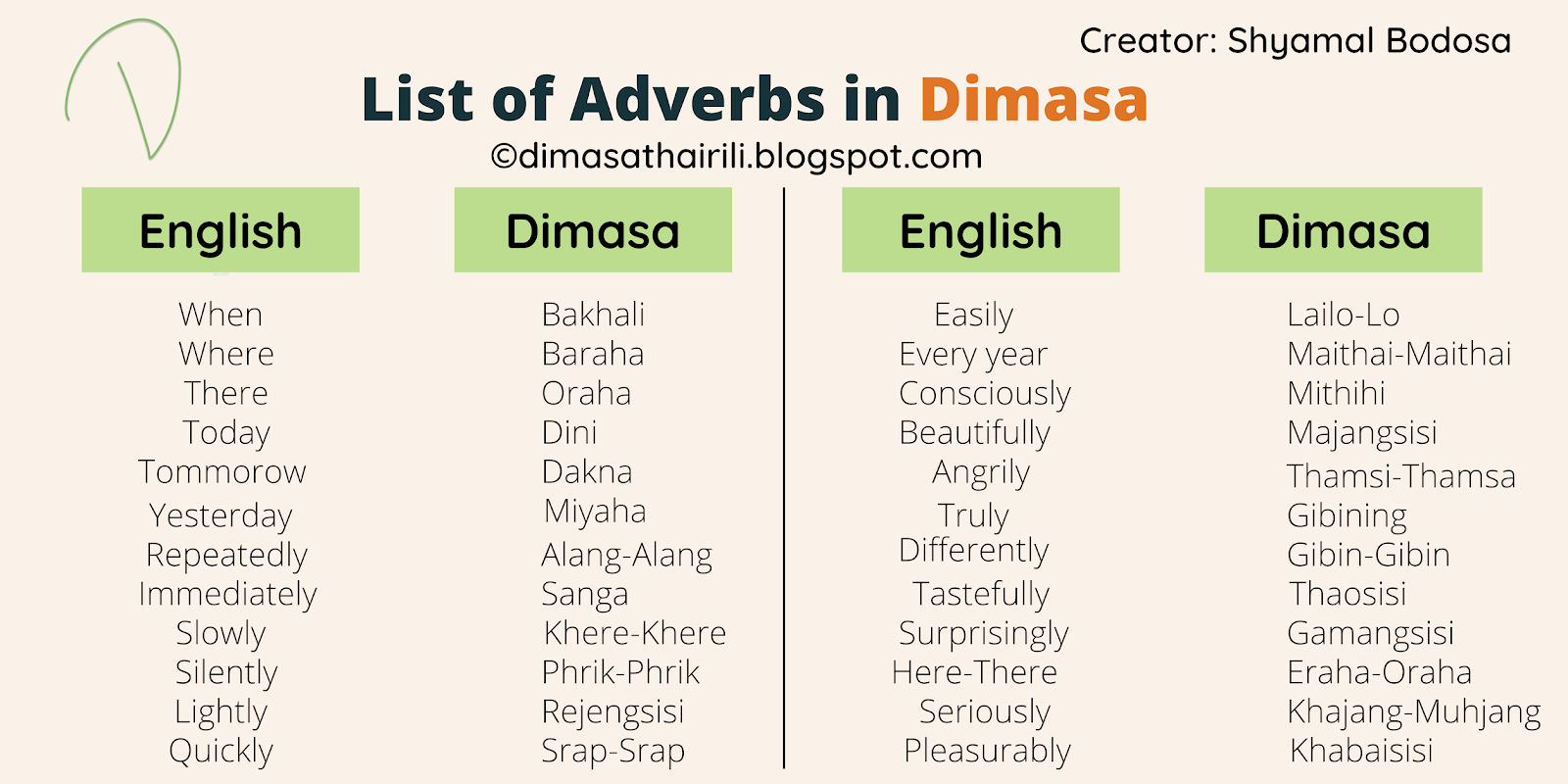
List of 50+ Adverbs in Dimasa
table {
border-collapse: collapse;
width: 100%;
}
th, td {
padding: 8px;
text-align: left;
border-bottom: 1px solid #DDD;
}
tr:hover {background-color: #D6EEEE;}
| No. | English | Dimasa |
|---|---|---|
| 1 | When | Bakhali |
| 2 | Where | Baraha |
| 3 | Here | Eraha |
| 4 | Today | Dini |
| 5 | Tommorow | Dakna |
| 6 | Yesterday | Miyaha |
| 7 | Before | Sagang |
| 8 | After | Yahon |
| 9 | The day before yesterday | Agasi |
| 10 | Repeatedly | Alang-Alang |
| 11 | Twice | Alangini |
| 12 | Gently | Baijang |
| 13 | Outside | Baijiha |
| 14 | Up | Basaoha |
| 15 | How | Bedehe |
| 16 | How much | Bisilai |
| 17 | Inside | Bising |
| 18 | Timely | Bubli jang |
| 19 | The day after tommorow | Dakna-soni |
| 20 | Now | Duha |
| 21 | Nowaday | Dini-dakna |
| 22 | This way/Such | Elai-khele |
| 23 | That much | Elai-sining |
| 24 | Here and there | Eraha-oraha |
| 25 | Soon | Sanga |
| 26 | Immediately | Sanga/Duhaning |
| 27 | In the middle | Gejerha |
| 28 | Truly | Gibining |
| 29 | Differently | Gibin-gibin |
| 30 | Surprisingly | Gamangsisi |
| 31 | Purely | Gtharsisi |
| 32 | Very | Hamsining |
| 33 | Well | Hamsisi |
| 34 | Mid day | Sainjar |
| 35 | Exactly | Thik olining jasosi |
| 36 | Seriously | Khajang-muhjang |
| 37 | Kindly | Khasaohi |
| 38 | Pleasurably | Khabaisisi |
| 39 | Openly | Khuruhi |
| 40 | Slowly | Khere-khere |
| 41 | Easily | Lailo-lo |
| 42 | Every year | Maithai-maithai |
| 43 | Consciously | Mithihi |
| 44 | Unconsciously | Mithiyahi |
| 45 | Beautifully | Majangasisi |
| 46 | So | Odebani |
| 47 | That also | Odebo |
| 48 | And | Odehe |
| 49 | Then | Bu bubli ha/Niykhade |
| 50 | Silently | Phrik-Phrik |
| 51 | Lightly | Rejengsisi |
| 52 | Quickly | Srap-srap |
| 53 | Angrily | Thamsisi-thamsasa |
| 54 | Tastefully | Thaosisi |
Adverbs of time:-
- Duha – Now
- Duha sinu –
Just now - Nalai –
Always - Bailumhi –
Late - Manang –
Formerly - Bakhali –
When
- Bakhaliba-bakhaliba
– Occasionally - Phorong –
Morning - Sarap –
Immediately - Dini –
Today - Dakhna –
Tomorrow - Soni – Day
after tomorrow - Miyaha –
Yesterday - Agasi – The
day before yesterday - Daglai –
This year - Minijang –
Last year
Adverbs of Degree or Measures:-
- Khaisa – Little
- Khaisasinu – Less
- Lai – Almost
- Gabang – Much
- Gabangnu – Very
Adverbs of Manner
Adverbs of manner admit of comparison and are compared in
the same way as adjectives, such as:-
- Bo hamsisi khalaidu – He does it well
- Bo hamdaosisi khalaidu – He does it better
- Bo hamdaothaosisi khalaidu – He does it best
- Bo hanganing thangkha – He went quickly
Conclusion
Hope that today you understood well the adverb and the type
of adverb, if it has helped you a little in understanding the adverb, then
share it. Juthai…
Explore More Related Articles
{
“@context”: “https://schema.org”,
“@type”: “Article”,
“mainEntityOfPage”: {
“@type”: “WebPage”,
“@id”: “https://dimasathairili.blogspot.com/2021/11/adverb-in-dimasa.html”
},
“headline”: “Adverb in Dimasa with Definition, Meaning and Examples – Dimasa Grammar”,
“description”: “The adverb is a word that describes the characteristics of other words except for Noun and Pronoun. The words that describe the characteristics of Noun and Pronoun are called Adjectives, where you can read here.”,
“image”: “https://blogger.googleusercontent.com/img/a/AVvXsEiUCD0oF-VEXrCKzxJlwC2RAjYwQCBqqbS6_klr0GJ7GLT_1jssGOwLQrScG-wyZWiHROu5A9qbQtanGwKBxbIPsHZ6iVVvtr_05xC-kEN4OW5KmAt_tI-rfNAiSjO50DYLuV29PECoR6ZRfYuxu2FKPzzyJru8Edts7YCs4cA9c2dTM5TE6C3Hf2HQzQ=s2508”,
“author”: {
“@type”: “Person”,
“name”: “Shyamal Bodosa”,
“url”: “https://dimasathairili.blogspot.com/p/about-of-this-sites.html#2”
},
“publisher”: {
“@type”: “Organization”,
“name”: “https://dimasathairili.blogspot.com/”,
“logo”: {
“@type”: “ImageObject”,
“url”: “https://dimasathairili.blogspot.com/favicon.ico”
}
},
“datePublished”: “2021-11-29”,
“dateModified”: “2021-11-29”
}