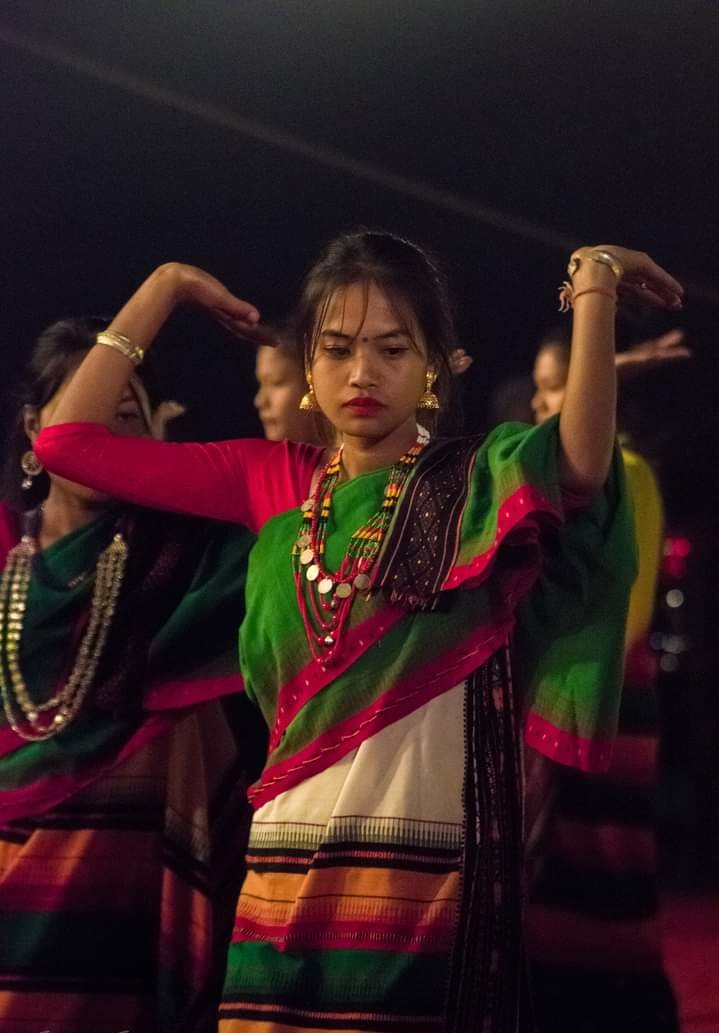

Baidima is a traditional folk dance of the Dimasa tribe. It is accepted as a traditional dance of the Dimasa and performed mainly during the harvesting festival of Busu Dima. Baidima dances are performed by young boys and girls on the dance floor. The dancers wear traditional outfits and colorful ornaments. It is characterized by gradually dancing steps with the music, with your hands on your waist and moving up & down. In this traditional dance, songs are used; the names of the songs are Nagasa Jaorere & Shivarai Baidima.
The meaning of Baidima: Bai means dance & Dima means Dimasa. Baidima dances are different kinds of dances, such as Baidima (Dima Hasao district), Baihawar (Cachar district), Baidembra (Hojai district), and the Dimasa people who dance the Baidima of Dimapur are called Baidijuwa. Baimaijai or Baijaba (It means a cultural performance with a stone sieve once a time during Dimapur’s reign, so-called Baimaijai/Baijaba. This dance is performed in the Dimasa-inhabited areas of Dima Hasao, Cachar, Hojai, Karbi Anglong districts, and Dimapur in Nagaland.
Read Also: Baimaijai: Another Dimasa Dance Form
FAQs on Baidima Traditional Dance
Q1. What is “Baidima”?
Baidima is a traditional folk dance organized by the Dimasa people.
Q2. Which songs are used in the Baidima folk dance?
In these traditional folk dances, the songs used are “Nagasa Jaorere” & “Shivarai Baidima“.
Q3. In which festival Baidima traditional dance celebrated?
Ans: During the Busu Dima festival.
Q4. What is the meaning of Baidima?
The meaning of Baidima is “Bai means Dance & Dima means Dimasa”; in full form, Dimasa dance.